
Table of Contents
A stakeholder engagement matrix isn’t just a chart, it’s a strategic framework that helps teams organize, understand, and connect with the people who influence a project.
But while matrices can bring clarity, real engagement requires something deeper. People don’t fit neatly into boxes, so if you’re leading your own engagement efforts for a project, treat the matrix as a starting point (not a substitute) for human judgment.
In this guide, you’ll learn:
- How stakeholder engagement matrices work and what they reveal
- The different types of matrices (with pros, cons, and use cases)
- Step-by-step instructions for building your own matrix
- Practical use examples for business, government, and nonprofit sectors
- How to move beyond the grid for a more holistic engagement strategy for your project
What is Stakeholder Engagement?
Stakeholder engagement is a powerful project management technique that helps you identify, understand and engage groups of people who can influence or are affected by your project. Effective engagement ensures communication, education, alignment, adoption, and support throughout the project lifecycle.
So, what is a stakeholder engagement matrix, and do I need one?
A stakeholder engagement matrix is a visual tool that helps assess key stakeholders and then categorizes stakeholders based on their level of engagement.
After a stakeholder analysis, an engagement matrix organizes stakeholders into 4 quadrants across two dimensions (like influence and education, for example). Once plotted on a matrix, an engagement team can more easily prioritize the people who are most influential or most affected by a project.
At its core, it a simple grid used to visualize an organization and assess:
- Who the most influential stakeholders are
- Which team members are most (or least) interested in the project
- Which stakeholders need to shift support in order to result in project success
Ultimately, it is a strategic tool that serves to help you plan communications and manage risks. While it can be too reductive for more advanced stakeholder management, it can be a useful starting point for understanding and visualizing stakeholder dynamics.
As an example, this is a simple 2×2 grid comparing levels of influence against level of project interest.
| Low Interest | High Interest | |
|---|---|---|
| High Influence | Keep Satisfied | Manage Closely |
| Low Influence | Monitor | Keep Informed |
This visual is a practical starting point for planning how you talk to different groups of people about your project. After grouping stakeholders on this particular matrix, a specialist would know who they need to persuade, who they need to inspire, and who they need to merely keep informed in order to ensure project success.
How to Engage Stakeholders
At LMGS, we don’t typically rely on a matrix for our stakeholder management. People are nuanced. They are more complicated than a 2 dimensional analysis, they shift with context, history, and even individual personalities, and a chart can only capture so much of that.
That’s also why some teams (especially those doing it themselves) find value in the matrix. It may not capture every nuance, but it offers a way to focus on one or two key factors instead of getting lost in all the complicated human variables.
Used intentionally, a stakeholder engagement matrix can:
✅ Create visual clarity in complex situations
✅ Prioritize communication and outreach
✅ Reveal engagement gaps that would otherwise be missed
✅ Align team members around shared priorities
The key to using a stakeholder engagement assessment matrix for your project is knowing what it is and what it isn’t good at. It’s a lens, not a full portrait. It can show some key players, but might miss others, and might fail to explain why they care, how they make decisions, or how their opinion might change over time.
However, as a starting point, a matrix is useful for grounding a conversation before diving into the deeper, human elements of influence and motivation.
Pick the Right Stakeholder Engagement Assessment Matrix For You
There are many different kinds of matrices, and one or more of them is likely to meet your unique project needs for engagement assessment. Below you’ll find the most common frameworks along with their advantages and disadvantages.
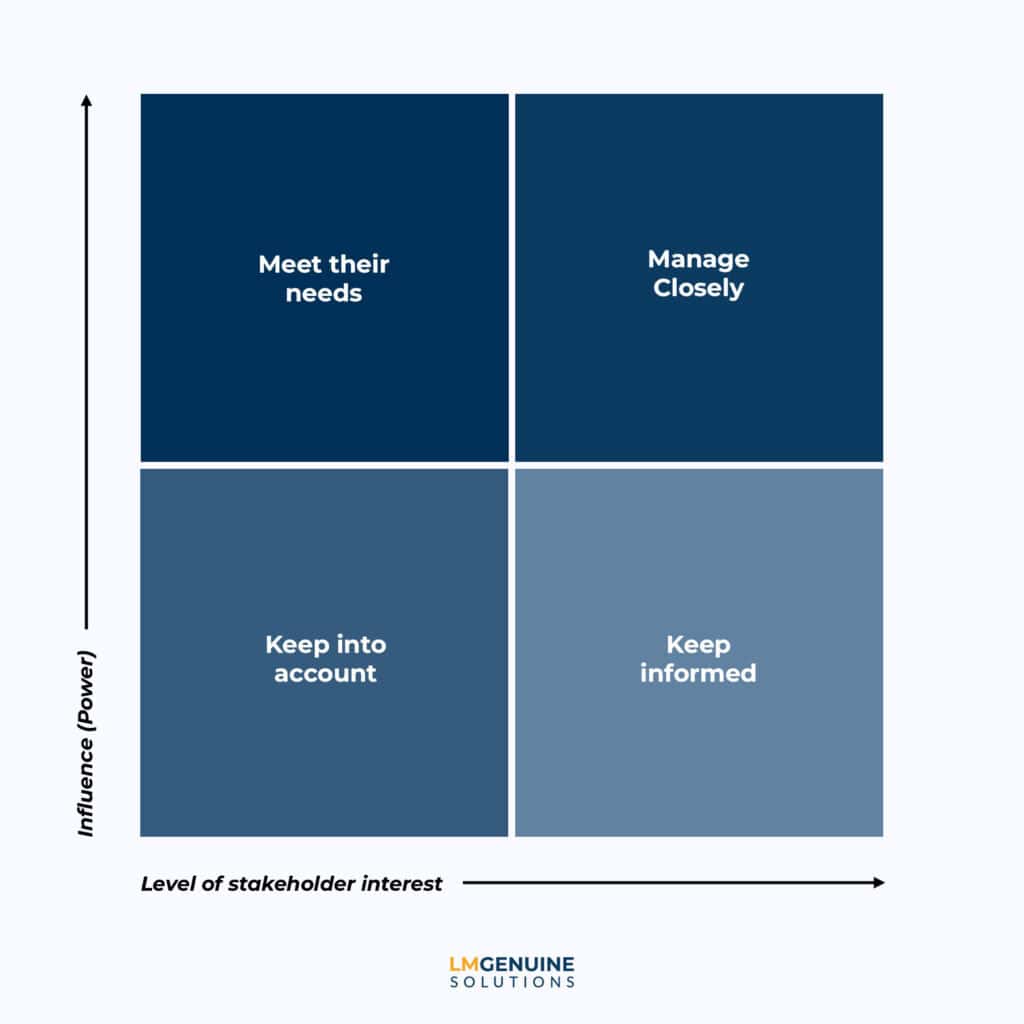
1. Influence–Interest Grid
Plot stakeholders by influence (power) and interest in the project.
Pros: Simple, actionable, easy to create
Cons: Oversimplifies nuance
Best for: General stakeholder prioritization
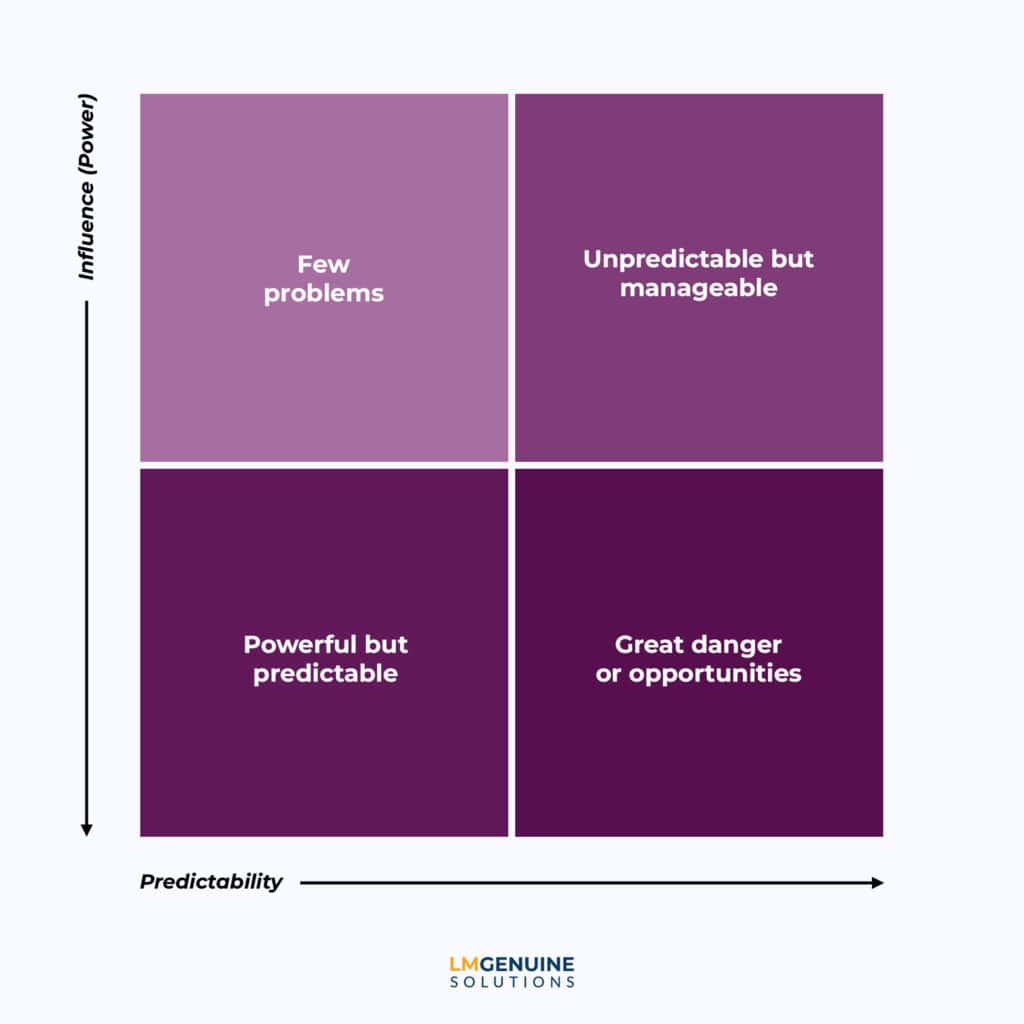
2. Power-Predictability Matrix
This matrix helps identify important stakeholders who are predictably challenging or generally unpredictable so that you can stabilize a high-volatility project.
Pros: Highlights risk and uncertainty
Cons: Predictability can be subjective
Best for: Construction, infrastructure, high-volatility project
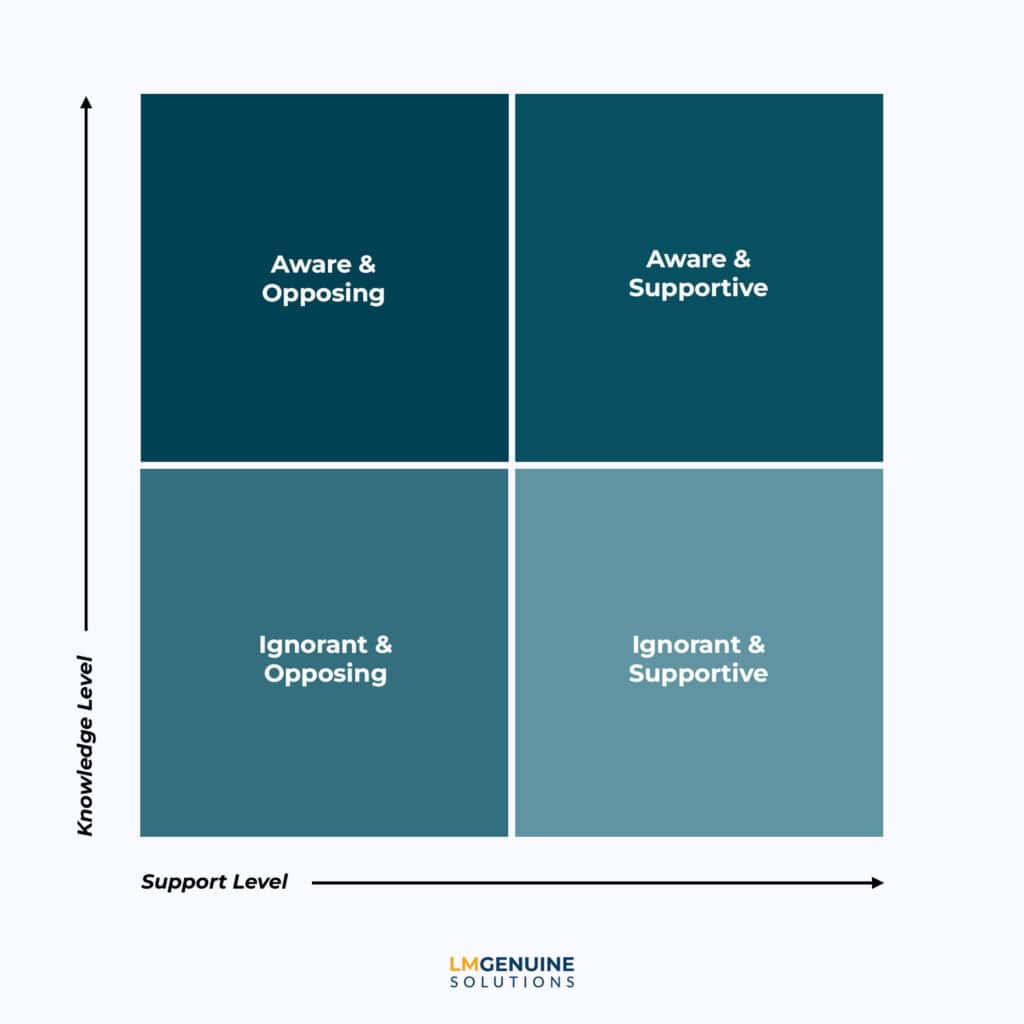
3. Knowledge–Support Matrix
Want to find out who is on your side, who’s against you, and who needs to know more? This is the matrix for you.
Pros: Great for planning communication and finding and creating project advocates
Cons: Requires qualitative judgment, hard to do
Best for: Nonprofits, policy initiatives, and community programs

4. Engagement Assessment Matrix (PMI Style)
This matrix is more complex, and allows you to place project stakeholders by how much they are currently engaging, and identify where you want them to engage.
Plots current vs. desired engagement level.
Pros: Directly shows engagement gaps
Cons: Time consuming; data heavy
Best for: Large, complex project management situations

5. Salience Model
This matrix is one of the most socially rigid, and practically fraught matrices. It is extremely limiting, and almost certainly misses “silent stakeholders” with hidden influencers. However, it is a classic model that you should be aware of that categorizes stakeholders by power, legitimacy, and the urgency to reach them.
Pros: Multi-dimensional view
Cons: Complex to interpret, misses the “silent stakeholder”
Best for: Political, organizational, or high-stakes environments
| Matrix Type | Axes | Use Case | Advantages | Best For |
|---|---|---|---|---|
| Power–Interest | Power vs. Interest | General mapping | Easy, fast | Broad projects |
| Power–Predictability | Power vs. Predictability | Risk-heavy projects | Reveals volatility | Construction, infrastructure |
| Knowledge–Support | Knowledge vs. Support | Advocacy planning | Targets education needs | Nonprofits, policy |
| Engagement (PMI) | Current vs. Desired | Gap analysis | Action-oriented | Formal project mgmt |
| Salience Model | Power, Legitimacy, Urgency | Prioritization | Multi-dimensional | High-stakes environments |
By understanding your needs and the strengths of each matrix, you can pick the framework that works best for you and for your specific project, while taking special care to keep “the human element” in mind.
Step-by-Step Guide: Building Your Stakeholder Engagement Assessment Matrix
If you’re managing project engagement yourself, an assessment matrix offers a structured way to simplify the complexities and focus your efforts. It’s not a substitute for genuine connection, but it’s a solid starting point. Here’s how to make the most of it:
Step 1 – Identify Your Stakeholders
First, you need to create an unordered list of everyone who is affected by your project. This includes team members, partners, funders, regulators, and community members.
Step 2 – Choose Your Characteristics
Next, refer to the above section to examine the pros and cons of each matrix to determine which is right for you and your project. If none is perfect, you can pick any two criteria and build your own stakeholder engagement assessment matrix!
Step 3 – Determine What You Need
Now that you have your list, and your characteristics, it’s time to consider your stakeholders. Where are they right now? Where do you want them to get to? What would that require from you?
As you do this, keep in mind that additional criteria might make a stakeholder more influential, more in-the-know, or more necessary to educate than a 2-dimensional grid may capture. That’s why it’s so important to include little notes about each person to include the human element.
Step 4 – Plot Your Stakeholders
It’s time for your project assessment. A facilitator needs to walk the team through an engagement analysis, encouraging the team to place each project stakeholder somewhere on your assessment matrix, and to rate them more or less heavily than other stakeholders along each axis.
Patterns will start to emerge, showing you who you’ll need to manage closely, keep informed, and where to focus extra effort.
Step 5 – Analyze and Act
Finally, once you have filled in your analysis matrix, you need to consider what actions you need to take in each quadrant, and for each outlier individual, in order to reach your project goal.
For instance, for a high-influence, low-support stakeholder you might need to schedule one-on-one meetings in order to involve them more in the decision-making.
Practical Examples of How to Measure Stakeholder Engagement Across Industries
Project engagement can be measured in multiple ways, including factors like participation in meetings, responsiveness to communication, or group progress toward certain outcomes.
If you are trying to conduct a stakeholder engagement assessment, you might be overwhelmed by the many things to consider. In order to help you see how it might work on a real project, we drafted the following hypothetical examples.
Healthcare – Influence-Interest Matrix
If you worked with a hospital implementing a new electronic health record (EHR) system, you would probably use an influence-interest grid to map out doctors, department heads, and IT staff. This shows you who needs closer collaboration and who needs less.
What the grid often misses, however, are subtler dynamics, like informal leaders among the nurses, or the frustrated clinicians juggling new tech that won’t stall rollout, but might decrease morale and uptake amid heavy workloads.
Construction – Power-Predictability Matrix
A city team planning a new pedestrian bridge downtown might use a Power-Predictability Matrix to plot local officials, contractors, suppliers, and community groups, and then determine how best to engage them.
For example, with a high-power, unpredictable stakeholder, like a city council member facing re-election, or a business owner concerned about construction noise, you should probably flag them as requiring extra attention during your assessment.
It is worth mentioning that the term “power”, though the official term, can be very limiting. We prefer to think of it as “influence”. A non-powerful, but socially influential community member could object to the bridge, and cause slowdowns and adoption stalls.
Government / Policy – Knowledge-Support Matrix
Imagine a state government putting together an infrastructure policy. They would be wise to leverage a Knowledge Base / Support Matrix to visualize stakeholders like planners, environmental groups, and residents.
Stakeholders with high knowledge but lower support receive extra communication, while less-informed ones get educational outreach. Don’t forget to add notes about missed nuances like competing departmental agendas or public sentiment shifts.
Best Practices
In order to get the most out of your stakeholder engagement matrix, it’s important to:
- Update it often. Team dynamics and priorities shift as your project goes on. Make sure to update your engagement assessment matrix regularly as things like engagement and education change over time.
- Engage early and broadly. It’s vital not to ignore “low-power” stakeholders. Not only might they wield informal influence that doesn’t make it onto the chart, but they often have vital insights you can leverage in your project.
- Layer in other perspectives. Human interactions can’t be fully reduced to two dimensions, so make sure to add in qualitative insights like personality clashes, hidden champions, or shifting alliances.
- Validate collaboratively. Sometimes, we make mistakes when we group people together. Bringing full groups, or focus groups from a quadrant together is important in order to find out if your plotting reflects real relationships, not just assumptions.
- Tailor communication. Remember: an assessment matrix is a guide, not a script. Two stakeholders in the same “quadrant” on paper may respond very differently depending on personality or organizational culture.
Used this way, your matrix becomes more than a static diagram. It is a framework that is used to assess stakeholders, becoming a map that helps you see the story behind your stakeholder relationships and act accordingly.
Still, even the best maps can miss the terrain, and that’s where a lot of people get stuck. A matrix can oversimplify or miss project nuances that matter, but an experienced partner helps you navigate what the grid can’t.
Move Mountains One Stakeholder at a Time
Stakeholder engagement can be messy and full of nuance. We help you navigate the human side in order to reach the right people and turn influence into real wins.
Frequently Asked Questions
What are the levels of stakeholder engagement?
The levels of stakeholder engagement are categorized mainly by the stakeholder’s current attitude (unaware, resistant, positive, negative) but it can also be modified by the type of interaction necessary to nudge them in a desired direction (educate, persuade, involve, collaborate.)
A facilitator can determine stakeholder engagement with an assessment (like sentiment analysis). After a stakeholder mapping, an expert will determine who needs to be nudged, how quadrants should be supported, and what the project scope will allow.
The desired end-level of engagement chosen depends on the project’s needs, but the goal is always to move stakeholders toward a more positive and involved state.
How do you improve stakeholder engagement?
After you conduct a stakeholder engagement assessment, it’s time to create a plan. In order to improve stakeholder engagement you have to begin with understanding your stakeholder motivation.
Facilitators can identify a key stakeholder and use tools like matrices alongside human-centered strategies, regular communication, and collaborative workshops to increase participation and support from that stakeholder.
What is a stakeholder engagement plan?
A good stakeholder engagement plan shows what groups of people need what communication from you in order to more successfully complete a project. It typically requires a team to categorize stakeholders, engage them with intentional strategies, and evaluate success with key metrics.
What are common challenges in stakeholder engagement?
People and projects can be complex, so when engaging stakeholders, common challenges include misaligned expectations, underestimating informal influence, over-reliance on rigid tools like matrices, ignoring social/cultural/political contexts, and not updating engagement plans as relationships and priorities evolve.
The desired end-level of engagement chosen depends on the project’s needs, but the goal is always to move stakeholders toward a more positive and involved state.
How can a stakeholder engagement consultant help?
When teams undertake stakeholder engagement themselves, they often resort to rigid tools like matrices and may fail to include important qualitative information. They also might struggle with implementing strategies to effectively move key stakeholders in a desired direction.
Depending on your desired engagement, a dedicated consultant can provide expertise in mapping complex relationships, help you analyze complicated dynamics, design effective engagement strategies, and bring an understanding of the complexities that a matrix or internal team may miss, which can be especially important for a large, high-stake, or sensitive project.
What is a stakeholder analysis matrix?
A stakeholder analysis matrix is synonymous with a stakeholder engagement matrix. They are both a tool that people use to analyze the influence and interest of stakeholders during a project. Though it may not consider complex human dynamics, a matrix can help prioritize engagement strategies around key stakeholders in order to bring about project success.
However, for those with bigger projects, it’s important to recognize that a matrix is just one method of stakeholder engagement. Ideally, these dynamics are afforded the complexity they deserve.
How do you conduct a stakeholder analysis?
A stakeholder analysis starts by identifying everyone who can influence or is affected by your project, then assessing their level of influence, interest, knowledge, and support. Many teams use a stakeholder analysis matrix to visualize these relationships, but the most effective analyses go further by adding qualitative notes about motivations, concerns, and informal influence.
The goal isn’t just to categorize people, it’s to understand who matters most, why they matter, and how your actions might shift their support over time.
How do you create an engagement plan?
A stakeholder engagement plan builds on your analysis by defining what engagement looks like for each stakeholder group and how you’ll achieve it. This typically includes communication strategies, engagement methods (inform, consult, involve, collaborate), timelines, ownership, and success metrics.
Strong engagement plans are flexible, updated regularly, and grounded in real human dynamics, not just static charts or assumptions made early in the project. Ideally, if you used an engagement assessment matrix, the plan and matrix are complimentary and actionable.
How do you increase engagement levels of key stakeholders? (and how to engage with stakeholders)
Increasing stakeholder engagement levels starts with understanding why someone is disengaged in the first place. Lack of engagement is usually caused by unclear incentives, insufficient information, low trust, or feeling excluded from decisions that affect them.
Once those drivers are identified, engagement can be increased by matching the right action to the right stakeholder.
Common ways to increase engagement through stakeholder management include:
- Educating stakeholders when resistance comes from uncertainty or lack of information
- Involving stakeholders earlier in planning and decision-making to build ownership
- Shifting communication style or frequency to better match stakeholder preferences
- Creating clear feedback loops so stakeholders see how their input influences outcomes
- Building trust through consistency by following through on commitments and timelines
Stakeholder engagement matrices can help identify where engagement needs to increase, but improvement happens through deliberate human interaction, not by moving dots on a chart. Engagement levels rise when stakeholders feel informed, respected, and meaningfully included in the process.